
AI is learning to control machines…but can it trust them?
AI Is learning to control machines...but can it trust them?
Anthropic’s new Model Hardware Standard (MHS) could mark an important step in the evolution of agentic AI.
Currently in research preview, MHS provides a standardized way for AI agents to discover, understand and operate physical equipment. Anthropic is already demonstrating the concept with laboratory and manufacturing equipment including robotic arms, microscopes, liquid handlers and laser systems.
The objective is compelling. Instead of spending weeks integrating different pieces of hardware, organizations could give AI agents a common interface through which they can orchestrate multiple machines.
But giving AI access to the physical world introduces a new security question.
How does the agent know that the machine it is controlling really is the machine it thinks it is?
Trusting the agent is only half the problem.
A great deal of AI security rightly concentrates on the agent. Is it authenticated? What is it authorized to do? Which tools can it access? What data can it see? What actions should require approval?
Once an agent starts controlling physical equipment, however, there are two identities in every transaction.
There is the identity of the agent issuing the instruction.
And there is the identity of the machine receiving it.
Imagine an authorized AI agent instructing a robotic arm to perform an operation. The instruction is valid and the agent has permission to issue it. But has the robotic arm itself been authenticated?
Could another endpoint be impersonating it? Could the device have been cloned or substituted? Is it genuine but compromised? Is it currently in a state in which the requested operation should be allowed?
For physical AI, those questions can become safety-critical. Discovery does not equal trust
MHS tackles an important interoperability problem by allowing agents to discover equipment, understand its capabilities and communicate through a common interface.
Machine identity addresses a complementary problem. It provides evidence that the physical machine behind that interface is actually the machine it claims to be. This distinction will become increasingly important as AI agents operate with less human supervision.
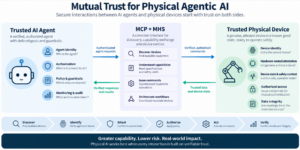
A useful model might be:
Discover → Identify → Attest → Authorize → Act → Verify
Before consequential commands are executed, the identity and trust state of both sides of the transaction should be established.
And what about the data? Device trust matters in the opposite direction too.
Anthropic describes closed-loop scenarios in which an agent receives information from equipment, evaluates the result and adjusts what happens next.
That creates a chain:
Device → Data → AI Decision → Physical Action
If the first link cannot be trusted, everything downstream becomes questionable.
An AI agent therefore needs confidence not only that it is sending instructions to the intended machine, but also that the data driving its decisions originated from the intended physical source.
Machine identity becomes part of data provenance. Zero Trust for the physical AI era
This is ultimately an extension of a familiar security principle: never assume trust simply because something is connected.
For agentic AI, being discoverable should not automatically make a physical device trustworthy.
Higher-risk environments will increasingly need cryptographic device identity, hardware-rooted attestation, authorization and continuous assessment of device trust alongside controls governing the AI agent itself.
Technologies already used to establish machine identity in connected products and operational environments offer one potential model.
For example, Device Authority’s Dynamic Device Key Generation technology is designed to establish hardware-rooted device identity and detect whether a machine is genuine rather than a cloned or substituted endpoint. Combined with policy-based authorization and credential management, the same principle could provide an AI agent with stronger evidence about the physical machine behind an MHS interface before allowing sensitive operations.
The specific implementation is less important than the underlying architectural principle.
As AI moves from generating content to taking actions in the physical world, agent identity and machine identity need to become two sides of the same trust relationship.
MHS could dramatically simplify how AI interacts with hardware.
The next challenge is making sure that when an AI agent reaches out to control the physical world, it can trust what is on the other end.